CBN Grinding Wheels – Knee Implants and Further Implant Applications
CBN grinding wheels and matching diamond dressers for cobalt-chromium knee components; further implant applications require separate process design.
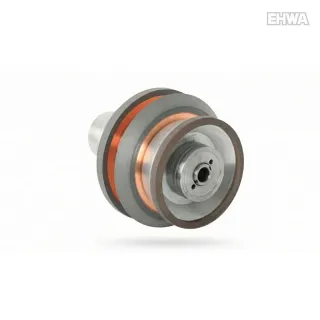
Manufacturing knee components requires precise contours, dimensions and surface quality. EHWA presents vitrified and electroplated CBN grinding wheels with matching diamond dressing rollers. The documented assignment concerns knee implants made from cobalt-chromium alloys.
Tool range for knee components
- Vitrified CBN grinding wheels: The knee document specifies VB-14F1 designs with B252L150VBW.
- Electroplated CBN grinding wheels: The document shows EB-1FF1 designs with specifications B427 or B252/B301.
- Diamond dressers: Profile and mounting are matched to the grinding wheel being dressed and the required component contour.
These specifications belong to the illustrated designs. They are not a universal recommendation for every implant, material or machine.
Contour and surface integrity
Grinding wheel, dresser, coolant and machine kinematics are designed together. Assessment covers contour and dimensional accuracy, surface quality, thermal effects, dressing intervals and useful tool life. Achievable values are verified in the actual manufacturing process.
Hip components and other materials
Hip components, femoral tapers, titanium alloys and ceramic pairings place separate demands on the abrasive, bond and process. The knee designs are not automatically transferred to these applications. State component drawing, material, heat-treatment condition, contact surface, mounting and required finish.
The actual tool design and associated cutting conditions are confirmed against the component material, geometry and machine.