CBN Segments – Brake Disc Machining
Segmented tools for brake-disc honing and grinding, matched to friction-ring material, coating and surface requirements.
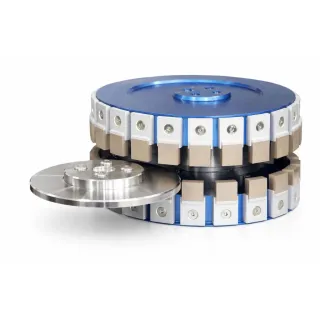
Friction-ring surface machining is matched to the substrate, coating and required function. EHWA presents distinct tool families: CBN segments for brake discs, ZAPEX-G honing stones and Mevious grinding tools. Honing and grinding each require their own tool and process design.
Tool families and process assignment
- CBN segments: The automotive document shows segmented tools for brake-disc machining. Bond, grit and mounting are confirmed for the particular design.
- ZAPEX-G: Honing stones and associated tool designs for friction-ring surface machining.
- Mevious: Grinding tools with a hybrid bond combining metal and vitrified constituents for suitable coated brake discs.
- Geometry: Segment dimensions and tool carriers are matched to the brake disc, mounting and machine.
Coated brake discs: source example
The EHWA ZAPEX-G and Mevious sheet compares the condition after laser cladding with the condition after grinding. The illustrated TiC top layer is 250 µm after cladding and 200 µm after grinding; the SUS intermediate layer is specified as 100 µm in both images on a cast-iron substrate. These values belong to the illustrated layers and do not define a general stock-removal allowance or target thickness for other coatings.
Assess surface and process together
- Match friction-ring topography and surface parameters to component function.
- Check coating integrity, dimensional accuracy and possible thermal damage in the actual process.
- Compare useful tool life and cycle time together with achieved surface quality.
The Mevious document’s reference to Euro 7 identifies its application focus. It does not establish the emissions performance of a braking system. Honing or grinding alone does not demonstrate vehicle approval.
Design your brake-disc machining process
State substrate, deposited layer, layer thickness, friction-ring geometry, machine, mounting and coolant. Abrasive, bond, grit designation and permissible cutting conditions are confirmed together before tool selection.