Camshaft Grinding
The camshaft controls the opening and closing of the intake and exhaust valves through defined lift movements. High contact pressures and dynamic loads place corresponding demands on dimensional accuracy, form accuracy, and surface quality.
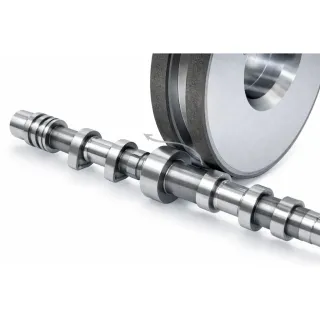
Process
Camshafts are predominantly made from cast iron or forged steel and are surface-hardened in their functional areas. These high surface hardnesses place particular demands on economical, process-stable grinding.
EHWA has designed ceramic-bonded CBN grinding wheels for this purpose that enable form-stable, tool-life-optimized grinding – in both series and high-performance processes.
What the process gains
Longer dressing intervals
Stable profile accuracy of the cam contour, reduced downtime
Consistent form and surface quality
Reproducible cam profiles over the entire tool life
Reduced thermal load
Minimized risk of grinding burn and microstructural changes
High profile stability
Precise reproduction of complex geometries even over long production runs
Recommended tools
| Product types | Cylindrical and profile grinding wheels for cam and journal locations |
|---|---|
| Bond | VEWN – EHWA ceramic bond |
| Grit sizes | B76 – B151 |
| Dimensions | Wheel diameter up to Ø 650 mm |
| Design | Customer-specific, based on machine concept, cam geometry, and process requirement |
Process example
CBN profile grinding of camshafts made from cast material (FCD)
| Material | Nodular cast iron (FCD) |
|---|---|
| Workpiece diameter (journals) | approx. 60 mm |
| Grinding method | Profile grinding of the cam contour |
| Grinding wheel diameter | Ø 650 mm |
| Peripheral speed | 80 m/s |
| Feed rate | 0.05 mm/s |
| Total radial stock removal | approx. 1.2 mm |
Result
- Extended dressing intervals with stable profile accuracy
- Consistent cam contour over the entire tool life
- Reduced dressing effort and higher machine availability
Figures from an approved customer process. Tools are always engineered around the machine, workpiece, and process of the individual case – these figures are evidence, not a guarantee.