Indexable Insert Grinding
When cylindrical and surface grinding indexable inserts made of carbide, cermet, or PCD/PCBN, dimensional accuracy, cutting-edge quality, and process stability are the central concerns.
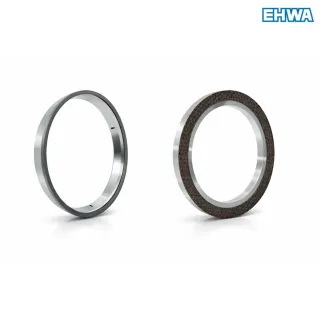
Process
Resin- and hybrid-bonded diamond or CBN grinding wheels enable economical grinding of peripheral surfaces, clearance faces, and flat seats at high feed rates and defined dressing intervals.
Resin-bonded tools offer a damping bond characteristic with homogeneous surface quality. Hybrid bonds combine high profile stability with improved tool-life behavior – especially for short cycle times in automated production lines.
What the process gains
Longer dressing intervals
Reduced downtime, higher net machine runtime
Consistent cutting-edge quality
Reproducible dimensional and form accuracy over the tool life
Reduced thermal load
Minimized risk of micro-chipping at the edge
Recommended tools
| Product types | Cylindrical and surface grinding wheels for indexable inserts |
|---|---|
| Abrasive | Diamond for carbide, cermet, ceramics · CBN for PCBN substrates and hardened steels |
| Bonds | Resin bond (standard and high-performance) · hybrid bond |
| Grit sizes | B46 – B181 |
| Dimensions | Ø 75 – 400 mm, special sizes up to Ø 500 mm |
Process example
Cylindrical and surface grinding of carbide indexable inserts
Goal: Increase tool life while maintaining consistent edge preparation of 8 – 12 µm
Compared to conventional resin bond
| Material | Carbide K20 – K40 |
|---|---|
| Machine | Agathon 400 PENTA |
| Cylindrical grinding wheel | Diamond, hybrid bond, B126 |
| Surface grinding wheel | Diamond, resin bond, B91 |
| Peripheral speed | 18 – 22 m/s |
| Feed rate | 0.2 – 0.4 mm/s |
| Infeed | 0.01 – 0.03 mm per stroke |
| Coolant | Oil |
Result
- Dressing interval extended by approx. 20 % at the same profile accuracy
- Ra 0.15 – 0.25 µm stable over the entire tool life
- No micro-chipping at the edge in series production
Figures from an approved customer process. Tools are always engineered around the machine, workpiece, and process of the individual case – these figures are evidence, not a guarantee.