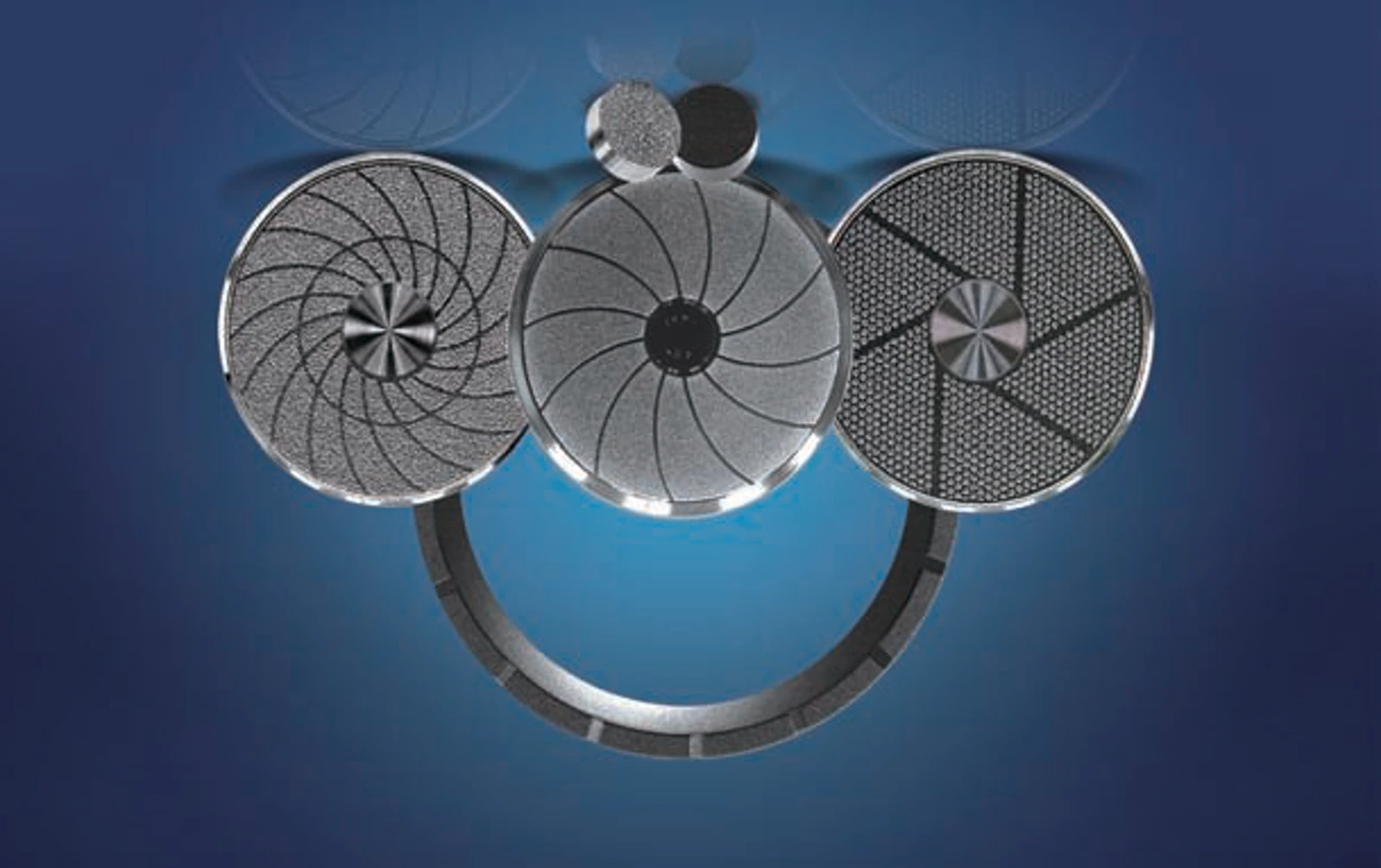
CMP pad conditioning in front-end processing
The EHWA front-end documents primarily cover diamond conditioners for chemical mechanical polishing. The conditioner works directly on the polishing pad surface. Its role is to maintain a pad structure suitable for the CMP process and support the required polishing performance over time.
The wafer, pad, slurry and conditioner form an interacting system. Tool design considers the material being polished, the pad structure and the slurry in use. Consistent tool geometry and a suitable contact area can help limit changes in the pad surface during its useful life.
Applications and selection considerations
| CMP task shown in the source | Relevant process information | Tool relationship |
|---|---|---|
| Oxide CMP, including BPSG, TEOS or PSG | Layer material, pad and slurry | Diamond pad conditioner |
| Metal CMP, including Al, W or Cu | Metal/slurry system and surface target | Matched conditioning design |
| STI, poly-Si or TSV-related CMP stages | Specific process stage and pad structure | Application-specific design |
| Open or closed pad structure | Pad type, contact conditions and wear | Tip count, arrangement and geometry |
These examples are applications listed in the original EHWA documents. Machine models mentioned there do not replace a check of the mounting arrangement and current equipment configuration. Tool selection therefore considers the actual condition and configuration of the polishing system.
Engineering the CVD tip contact
CVD conditioners use diamond deposited on a patterned substrate. The sources show defined tips with flat contact faces. Tip size, count, height, shape and arrangement are used to tune the interaction with the pad. This tool concept differs from individual diamond grains retained in a metal bond.
EHWA describes uniform tip geometry and a consistent contact area as features supporting sustained pad removal. A suitable design can help maintain pad roughness and more consistent polishing performance. The source also describes chemical stability and reduced metal contamination as development goals. Resistance to a particular chemistry must be considered in relation to the actual process fluid.
The front-end collection also includes conventional and BSL-related conditioning designs. Selection therefore starts with the required pad behaviour rather than with a technology name alone. Contact area, pad removal and tool utilisation are considered alongside the CMP result.
Assess pad removal and wafer removal separately
The CVD source explains how tip size and tip count influence conditioning. PCR means pad cut rate. Material removal on the wafer is a different measurement. Sustained PCR can support the pad surface but does not by itself establish a particular wafer removal rate or a guaranteed defect result.
The catalogue compares pad roughness and pad removal over pad life. Its useful engineering message is the relationship between tool contact, pad structure and polishing behaviour. An application assessment therefore considers pad removal, wafer removal, surface or topography requirements and usable pad life together.
This also prevents high removal values from being judged in isolation. An aggressive conditioner can change the pad more rapidly. The appropriate tool needs to combine the required pad condition with the desired wafer result and acceptable pad consumption. EHWA tool design addresses this combination within the specific polishing process.
Discuss your CMP task
Provide the layer material, process stage, polishing pad, slurry and equipment. Existing conditioning data and trends in pad removal, wafer removal or defects help establish the starting point. A mounting drawing or specification is also useful. Begin with the available information and use the technical discussion to identify the remaining details needed for tool selection.
EHWA Europe: info@ehwadia.de · +49 6173 997780
Sources and original documents
- EHWA: CVD Diamond Coated Pad Conditioner · PDF pages 1–4.
- EHWA: CMP Pad Conditioner and CVD Conditioner · PDF pages 1–3.
- EHWA: Diamond Coated Pad Conditioner · PDF pages 1–4.