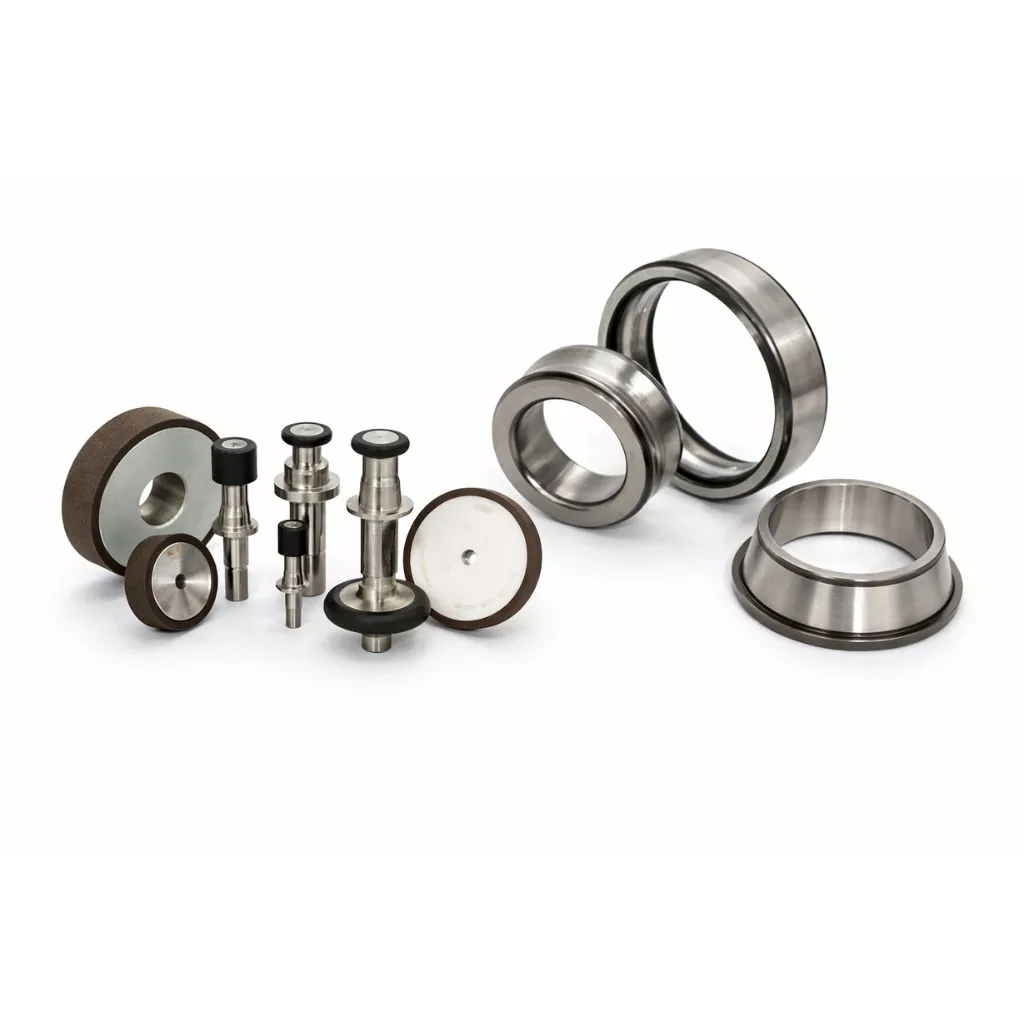
Vitrified-bond grinding wheels for ring machining
EHWA offers vitrified-bond CBN grinding wheels for bearing ring machining. Tool design combines abrasive, bond and body with the requirements of the machining surface. Component geometry and machine determine the appropriate design.
| Bearing component | Machining surface shown |
|---|---|
| Inner ring | Bore and raceway |
| Outer ring | Raceway, ribs and end faces |
Process benefits
The EHWA catalogue describes high stock removal rates and lower grinding forces, and reduced mechanical and thermal loading of the workpiece. A suitable design can support short machining times and lower loading of the workpiece and spindle.
Surface finish, cylindricity and dimensional accuracy are central considerations. Grinding wheel and dressing process are coordinated to maintain the required profile and working surface of the wheel throughout machining.
Tool features
| Feature | Catalogue designs |
|---|---|
| Abrasive | CBN |
| Bond type | Vitrified bond |
| Body | Ceramic, steel or aluminium |
| Further designs | With spindle or threaded spindle |
| Tool design | Based on drawing, machining surface, mounting and process |
Body and bond are different tool features. The designs shown provide the basis for selecting a suitable combination for your application.
Catalogue example: bore grinding
| Feature | German EHWA catalogue value |
|---|---|
| Wheel peripheral speed | 30-80 m/s |
| Workpiece stock allowance | Ø 0.1-1.0 mm, diametrical |
| Dressing stock removal | 3-30 µm total |
| Dressing tool | Rotary dressing tool |
| Grinding fluid | Oil or emulsion |
Source: German EHWA grinding catalogue, page 28. These values describe the application example shown there. The original English bearing catalogue gives partly different stock allowance and dressing values. For your process, source, tool and machine are considered together; the permissible speed is determined by the marking on the specific grinding wheel.
From the example to your tool solution
The following details support the technical assessment of your tool solution:
| Area | Your information |
|---|---|
| Component | Bearing type, ring, drawing and machining surface |
| Material | Designation, hardness and heat treatment condition |
| Requirements | Dimensions, form tolerances and surface parameters |
| Existing process | Allowance, existing surface and tool |
| Machine | Model, process and tool mounting |
| Dressing and cooling | Dressing tool, process data and grinding fluid |
When stating the allowance, identify the direction of stock removal: for example, diametrical or radial for bores and raceways, or axial for end faces. To assess dressing, provide the total removal, infeed per step and number of dressing steps.
Also state your objective: replacing an existing wheel, improving a surface, or developing machining time and tool life. Start with the information available; open points can be clarified during the discussion.
Your contact
Fatih Genc · Technical Sales
- Email: genc@ehwadia.de
- Telephone: +49 (0) 6173 - 99 77 821
- Submit a technical enquiry
Please mention "CBN grinding tools for bearing rings" and the relevant machining surface.