PCBN hard turning with MQL: evaluating tool wear and surface integrity together
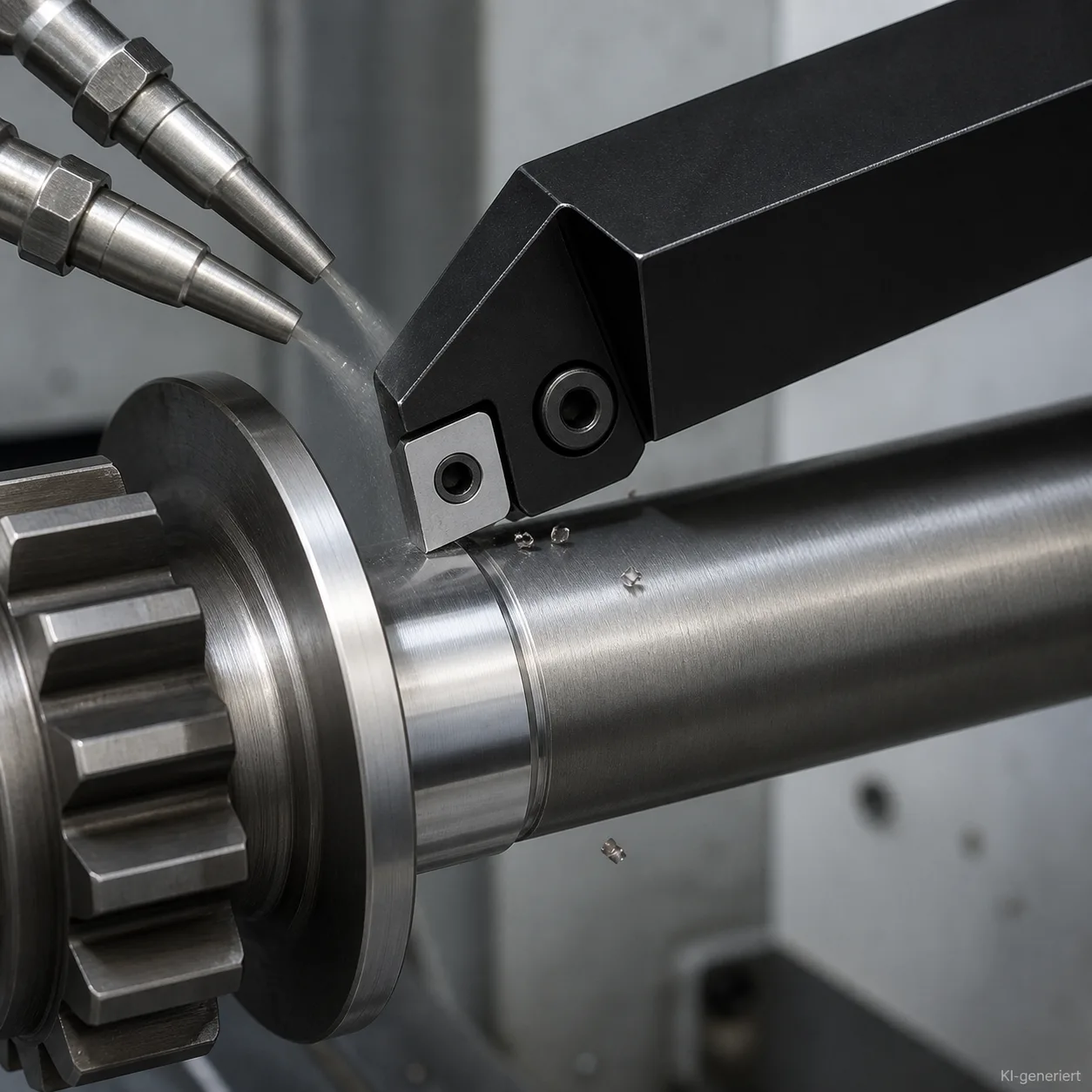
Hard turning can be an economically attractive complement to grinding for rotationally symmetrical components. However, the decision should not be based on achievable roughness alone. Tool wear, thermal loading, and changes in the workpiece surface layer need to be assessed together. A study published in 2026 on hard turning of case-hardened SAE 8620 steel illustrates how the lubrication strategy can influence these factors.
The researchers investigated gas-carburized, quenched, and tempered steel with a surface hardness of 58–62 HRC and an effective case depth of 0.8–1.2 mm. A commercially available PCBN insert was used to compare dry machining with minimum quantity lubrication (MQL). In the experimental setup, approximately 40 ml/h of vegetable-oil-based lubricant was supplied through two compressed-air nozzles.
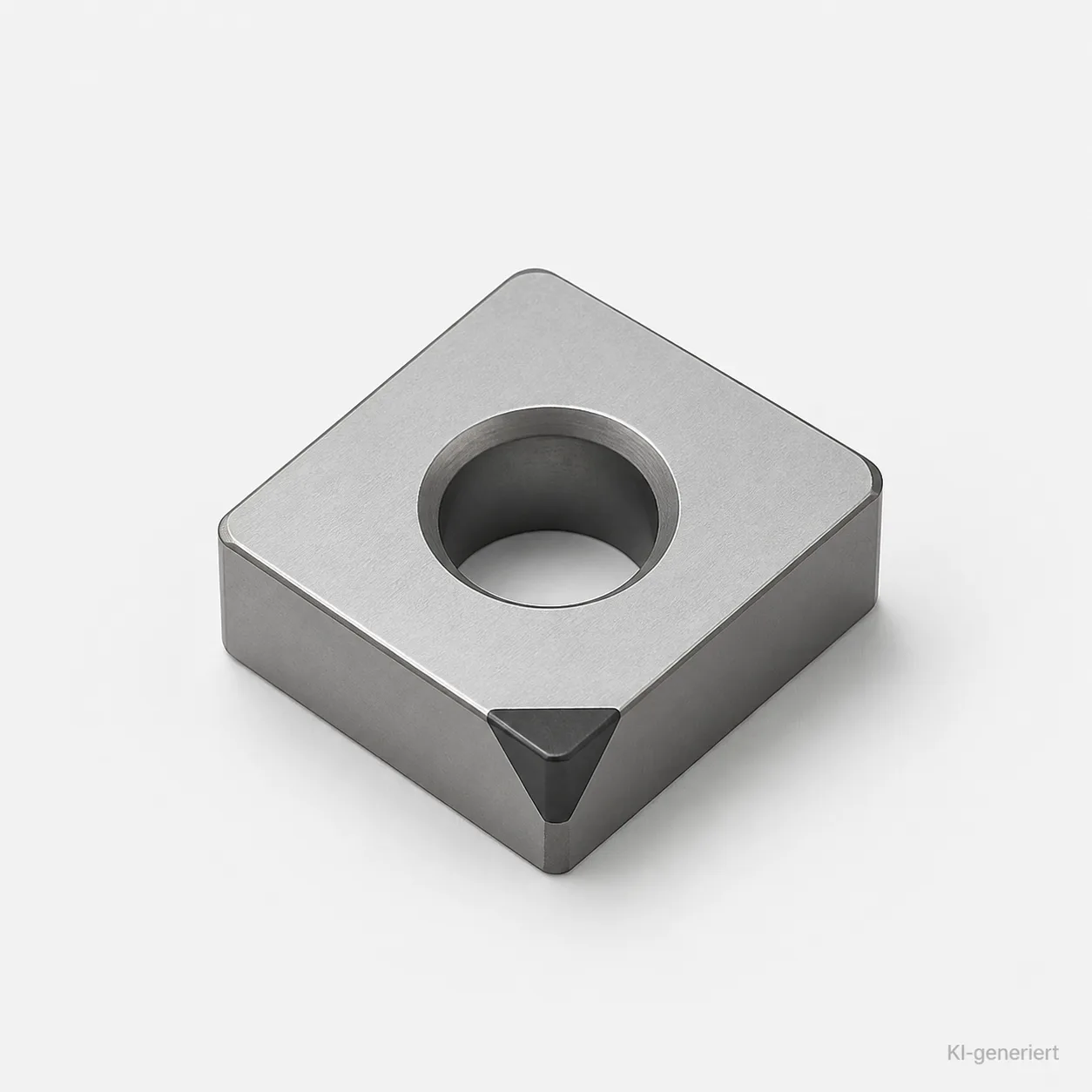
AI-generated illustration – not a photograph from the cited study or of an EHWA product.
Less wear under the tested conditions
Under the tested conditions, MQL reduced both flank wear and crater wear compared with dry machining. This matters in production because PCBN retains its hardness at elevated temperatures, yet the cutting edge is still exposed to a demanding combination of heat, friction, and abrasive microstructural constituents.
In SAE 8620, the carburized layer and its hard phases contributed to abrasive wear. The results are a useful reminder that nominal hardness alone does not fully describe the machinability of a case-hardened component. Carbide distribution, microstructure, and case depth also affect the dominant wear mechanism.
Roughness in the grinding range – not a blank check for substitution
The reported surface roughness remained below Ra 1.5 µm. For selected functional surfaces, hard turning can therefore reach a range often associated with grinding. This does not mean that grinding can be replaced universally. Form and dimensional tolerances, process capability, bearing area, residual stresses, and the subsequent function of the surface still need to be verified for the individual component.
Surface integrity: more than a roughness number
Surface integrity is particularly important. High thermomechanical loads can generate so-called white and dark layers. These microstructural changes cannot be identified from roughness data alone, but they may affect fatigue and wear performance.
In the reported tests, such layers occurred less frequently with MQL. White layers were sometimes thinner or not detected. This indicates lower local thermal loading, but it does not remove the need for component-specific metallographic validation where surface integrity is critical.
Three practical conclusions for process planning
First, the PCBN grade should be selected for the material, hardness profile, interrupted or continuous cutting condition, and actual machining allowance. Second, the MQL supply must reach the contact zone consistently — oil flow, air pressure, and nozzle orientation are therefore controlled process variables rather than secondary settings. Third, process approval should not rely on Ra alone. Tool life, dimensional stability, microstructural alteration, and, where relevant, residual stresses should also be assessed.
Economic assessment
The economic assessment should consider the complete process. MQL may reduce the consumption and treatment requirements of liquid media, but it requires stable dosing equipment and effective oil-mist extraction. Hard turning may also eliminate additional setups or subsequent grinding operations when the required tolerances can be achieved reliably.
Context for EHWA CBN tools
EHWA offers CBN indexable inserts for external turning in several ISO geometries, together with matching toolholders. This product family is generally relevant to the machining of hardened ferrous materials. However, the cited research used a tool supplied by another manufacturer. It therefore does not demonstrate a specific performance advantage for an EHWA grade. A reliable transfer requires the material condition, cutting data, edge geometry, and MQL concept to be engineered together and validated on the actual component.
Technical consulting
Would you like to discuss your application with us? Contact: genc@ehwadia.de